 GlucoSpike AI
Fish Before Rice vs. Meat Before Rice — Which Is Better for Blood Sugar?
Both fish and meat eaten before rice reduce your blood sugar spike. But there's a surprising difference in how they affect fat storage — and it comes down to the type of fat each contains.
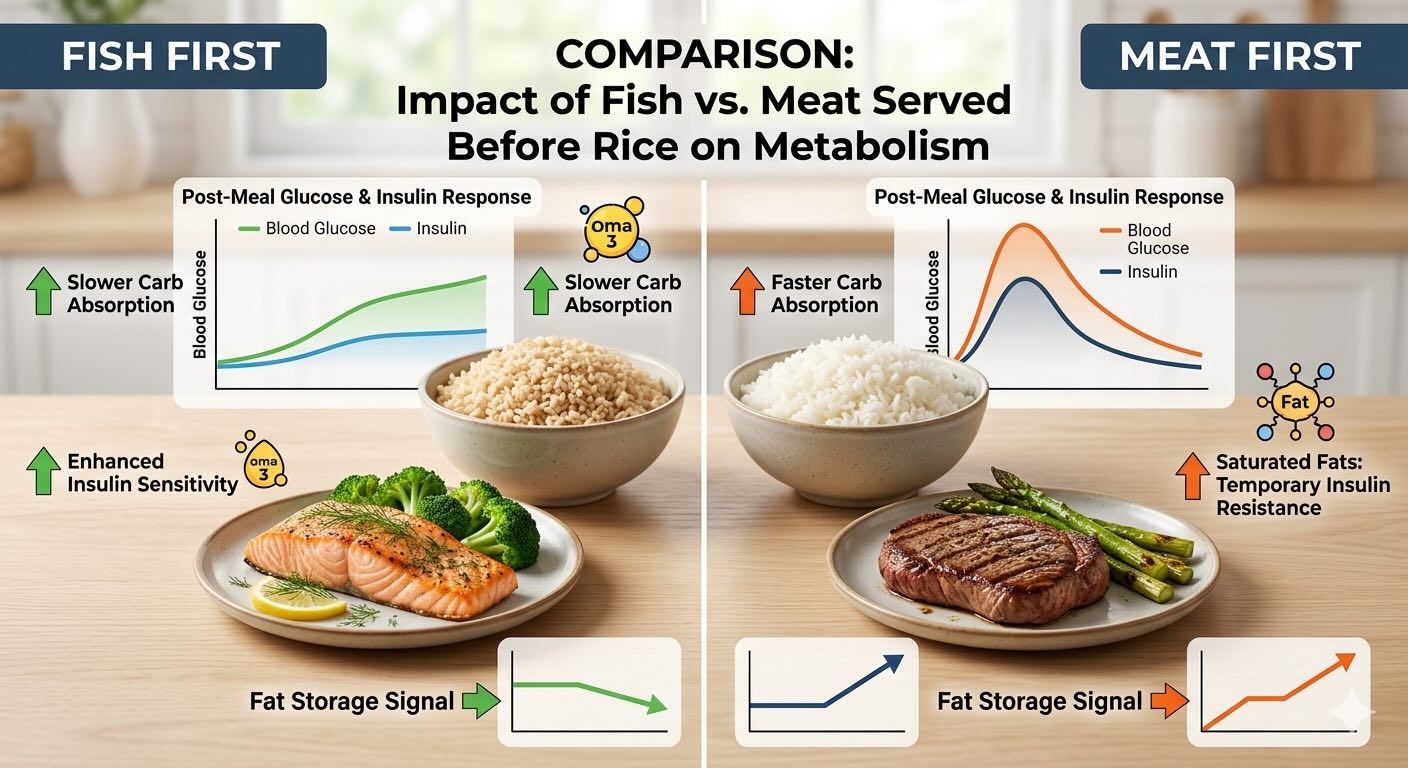
You've probably heard that eating protein before carbs helps reduce your blood sugar spike. And it's true — whether you eat fish or meat before rice, you'll get a meaningful reduction in post-meal glucose compared to eating rice first.
But here's what almost no one tells you: fish and meat produce very different hormonal responses, and one of those differences has implications for your body composition that go beyond blood sugar.
The nuance comes down to a hormone called GIP — and the type of fat in each protein source.
Key research finding: When fish (mackerel) and grilled beef were each eaten 15 minutes before rice in a crossover study, both reduced postprandial glucose and enhanced GLP-1. However, beef triggered significantly higher GIP secretion than fish — a difference attributed to saturated vs. polyunsaturated fat content. (Source: PMC7551485)
What GLP-1 and GIP Are (And Why They Both Matter)
When you eat protein and fat, your gut releases two key hormones called incretins:
GLP-1 (Glucagon-Like Peptide-1): The “good” one for blood sugar. It stimulates insulin, suppresses glucagon, slows gastric emptying, and suppresses appetite. More GLP-1 = better glucose management and better satiety. This is what Ozempic mimics.
GIP (Glucose-Dependent Insulinotropic Polypeptide): More complicated. GIP also stimulates insulin, which sounds good — but it also actively promotes fat storage in adipose tissue. Chronically high GIP is linked to fat accumulation, especially with diets high in saturated fat.
The critical finding from the research: fish and meat raise GLP-1 similarly, but meat raises GIP far more than fish. This is likely because meat is richer in saturated and monounsaturated fats, which are stronger GIP triggers, while fish is richer in polyunsaturated fats (especially omega-3s EPA and DHA), which trigger much less GIP.
The Comparison: Fish vs. Meat Before Rice
In the study, participants ate either 100g of steamed mackerel or 79g of grilled beef (similar protein and fat content) 15 minutes before 150g of rice. Both groups were then compared to eating rice first.
| Outcome | Fish Before Rice | Meat Before Rice |
|---|---|---|
| Post-meal glucose reduction | Significant ✓ | Significant ✓ |
| GLP-1 secretion | Enhanced ✓ | Enhanced ✓ |
| Gastric emptying delay | Yes ✓ | Yes ✓ |
| GIP secretion | Minimal | Significantly elevated |
| Implication for fat storage | Neutral | Potential long-term weight gain |
Short-term blood sugar control: essentially the same. Long-term body composition: fish wins.
The researchers noted that while meat before carbs suppresses postprandial hyperglycemia in the short term, the higher GIP secretion from saturated-fat-rich meat dishes may promote fat accumulation over time if eaten this way frequently.
The Fat Type Is the Key
This isn't a fish vs. meat debate broadly — it's specifically about the type of fat:
- Saturated fatty acids (SFA) — found mainly in beef, pork, lamb, and dairy fats — are the strongest GIP triggers
- Monounsaturated fats (MUFA) — found in chicken, some beef cuts, olive oil — are moderate GIP triggers
- Polyunsaturated fats (PUFA), especially omega-3s — found mainly in fatty fish (salmon, mackerel, sardines, tuna) — trigger very little GIP
Fish like mackerel and salmon are particularly effective because they're rich in EPA and DHA (omega-3s), which appear to not trigger GIP the way saturated fats do — while still delivering all the protein needed to activate GLP-1 and delay gastric emptying.
GlucoScore Comparison: Fish vs. Meat Preload Before Rice
| Meal Configuration | GlucoScore | Notes |
|---|---|---|
| Rice alone (150g) | 2–3/10 | No protein buffer |
| Grilled beef → rice | 6/10 | Good glucose outcome, higher GIP |
| Steamed fish → rice | 6–7/10 | Good glucose outcome, minimal GIP |
| Fish → vegetables → rice | 7–8/10 | Best overall: glucose + body composition |
What This Means Practically
If blood sugar is your only concern, both fish and meat eaten before carbs are effective and roughly equivalent.
If you're also watching your body weight, body fat, or have been diagnosed with conditions linked to fat storage (obesity, PCOS, fatty liver), then the type of protein you eat before carbs matters beyond glucose. Fish — especially fatty fish rich in omega-3s — is the better preload.
Practical protein preload hierarchy (best to least, for both glucose and fat metabolism):
- Fatty fish (salmon, mackerel, sardines, tuna) — highest omega-3, lowest GIP trigger
- Lean fish (cod, tilapia, basa) — lower fat overall, good glucose effect
- Chicken/turkey — moderate fat, mostly unsaturated
- Eggs — mixed fat profile, strong protein effect
- Beef/pork/lamb — effective for glucose, higher GIP due to saturated fat
Who Should Pay Attention to This Distinction
The fish-vs-meat difference matters most if you:
- Are managing both blood sugar and body weight or visceral fat
- Have PCOS (where both insulin resistance and fat distribution are concerns)
- Eat red meat as your primary protein at multiple meals per day
- Already follow meal sequencing and want to optimise beyond just glucose
For occasional meals, the difference is small. For a daily habit — like eating meat before rice at every lunch — the cumulative GIP effect over months is worth thinking about.
Frequently Asked Questions
Is fish better than meat for blood sugar?
For post-meal glucose specifically, fish and meat eaten before carbohydrates produce similar reductions in blood sugar spike. Where fish wins is in its lower GIP secretion — meaning less fat storage signalling — due to its higher polyunsaturated fat (especially omega-3) content.
What is GIP and why does it matter?
GIP (Glucose-Dependent Insulinotropic Polypeptide) is a gut hormone released in response to fat and carbohydrate intake. It stimulates insulin secretion but also promotes fat storage in adipose tissue. Saturated fats trigger significantly more GIP than polyunsaturated fats, which is why meat-heavy diets may promote fat accumulation even when blood sugar is controlled.
Does the cooking method change the effect?
Possibly. The research used steamed mackerel and grilled beef. Frying adds additional fat (often saturated), which could increase GIP further. Steaming, baking, or grilling is preferable for pre-meal protein if you're trying to minimise GIP.
Can I use plant protein instead?
Legumes (lentils, chickpeas) are a strong option — high protein, high fiber, low saturated fat, and very low GIP trigger. They're not as fast-acting as fish or whey for the pre-meal GLP-1 effect, but eaten as the first component of a meal they provide excellent glucose buffering with no fat-storage concern.
How does GlucoSpike account for this?
GlucoSpike AI scores the glucose impact of the full meal, including your protein source and its fat profile. When you log fish vs. beef alongside rice, the GlucoScore reflects the full metabolic context — and the app flags meals low in protein or high in saturated fat as areas to improve.
Want to compare your protein choices and their glucose impact? GlucoSpike AI scores any meal in seconds. App Store · Google Play
🥗 Get weekly blood sugar tips from GlucoSpike
Practical meal tips, glucose-friendly recipes, and app updates — straight to your inbox. No spam.