 GlucoSpike AI
Reactive Hypoglycemia - Why You Crash After Eating
Feel shaky, brain fog, or exhausted 2 hours after eating? Learn what reactive hypoglycemia is, why your glucose crashes, and how to prevent it with meal timing.
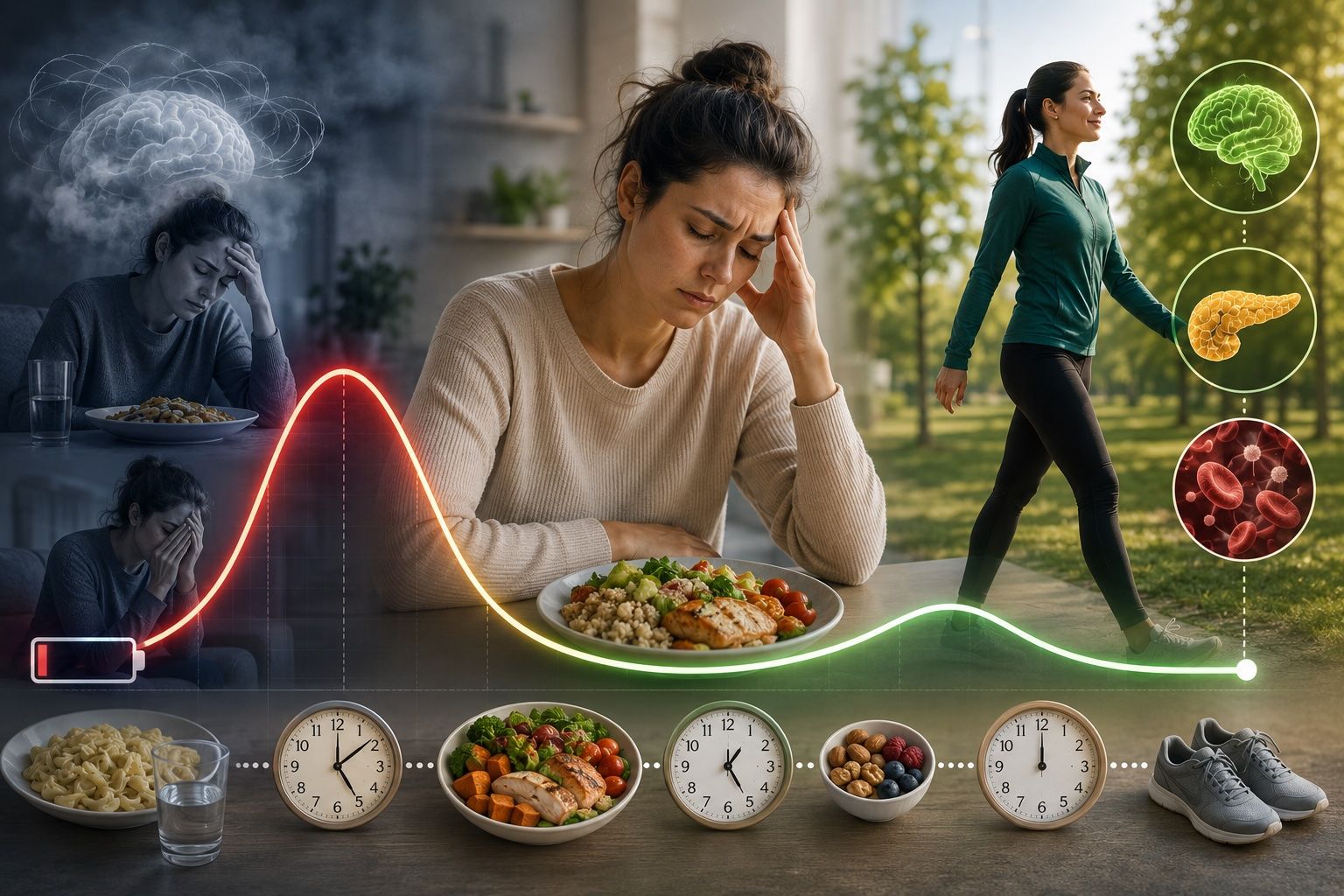
You eat a big breakfast. Energy soars. Then 2 hours later, you hit a wall. Brain fog. Shaking. Craving sugar again.
You think: "I just ate. Why do I feel like I'm starving?"
That's reactive hypoglycemia. Your glucose spiked, your pancreas released a lot of insulin, and now your glucose crashed below where it started. You're not hungry. You're dysregulated.
Here's what's happening
After you eat carbs, your blood glucose rises. Your pancreas detects it and releases insulin to bring it back down. That part is normal.
But in reactive hypoglycemia, the insulin response is delayed and then overshoot. Your glucose goes up, then the pancreas floods the system with insulin (after a lag), and glucose drops too fast and too low.
You drop from 160 to 80 in 30-45 minutes. Your body feels it: shakiness, cold sweat, anxiety, intense hunger, brain fog.
The irony: you're not low in an absolute sense (80 is normal fasting glucose). You're low relative to where you just were. Your body felt high, now it feels low, and that contrast triggers the crash symptoms.
The symptoms people describe
From the Reddit data, this pattern showed up constantly:
- "I feel anxious 2 hours after eating, like something's wrong"
- "Brain fog hits suddenly, I can't think"
- "Shaky, sweaty, heart racing — like I'm about to pass out but my glucose is 85"
- "Energy crashes hard, I need sugar or I'll fall asleep"
- "I get angry and irritable for no reason 2 hours post-meal"
These aren't signs of low glucose. They're signs of rapid glucose decline. Your body senses the speed of the drop more than the absolute number.
This is different from diabetes-type hypoglycemia (where glucose is genuinely dangerous, like 50-60). This is reactive — it comes after eating, and it's your system overcompensating.
Why it happens
Several metabolic patterns lead to reactive hypoglycemia:
1. High insulin sensitivity with delayed response
Some people (especially younger, more insulin-sensitive folks) release insulin slowly at first. Glucose climbs. Then, 30-45 minutes in, the pancreas realizes "oh, we're high" and floods the system. Overshoot. Crash.
2. High carb load without adequate protein/fat
Carbs alone spike glucose fast. The higher the spike, the stronger the insulin response. Protein and fat slow glucose absorption, reducing the spike and the compensatory insulin dump.
3. Fasting state before eating
If you haven't eaten in 12+ hours, your glucose is lower, your insulin sensitivity is higher. When you eat carbs, the rise is steeper and the insulin response is more aggressive. More crash.
4. Specific trigger foods
Some meals consistently trigger crashes. High-glycemic carbs (white bread, sugary cereals, juice) cause bigger spikes and bigger crashes. Refined carbs spike and crash. Whole grains + fat = slower, steadier.
How to tell if it's reactive hypoglycemia vs. other things
The key signature: crash timing and pattern.
Reactive hypoglycemia happens 1-3 hours after eating. It's predictable. Eat this meal, crash in 90 minutes. Eat that meal, no crash.
If you had a CGM (or tracked glucose), you'd see the pattern: meal → spike to 160+ → sharp drop to 85-95 in 30 minutes → symptoms hit.
If your glucose is actually 80-90 and you feel crashed, that's reactive hypoglycemia.
If you're truly hypoglycemic (50-65 range), you'd know it: impaired cognition, difficulty speaking, potential seizure risk. Reactive crashes feel bad but aren't dangerous.
The real patterns from the community
Reddit data showed:
- Pattern 1: Breakfast of cereal or toast → crash at 10am → need coffee/snack to recover
- Pattern 2: Lunch of burger + fries (high carb, moderate fat) → 2pm energy crash → afternoon fog
- Pattern 3: Skipped breakfast, big lunch → worse crash (fasting amplified sensitivity)
- Pattern 4: Same meal, different results depending on what was eaten before it (context matters)
People who tracked this reported: "When I eat protein and fat WITH my carbs, the crash doesn't happen."
The mistake people make
Most people blame the food itself: "Bread makes me crash" or "Sugar gives me a sugar crash."
Technically true. But the root cause is the glucose trajectory, not the food.
The solution isn't "avoid carbs." It's change how your glucose rises and falls:
- Eat protein/fat first, carbs last (slows absorption, smaller spike, smaller crash)
- Pair carbs with fiber (slows glucose rise)
- Eat smaller portions of high-glycemic foods (less spike = less insulin dump = less crash)
- Walk after eating (reduces peak, reduces the drop needed to come down)
- Don't fast before big meals (gives your baseline room to crash into)
What about testing?
If you have access to a CGM or can do a fasting glucose + glucose tolerance test, you'd see the pattern clearly.
But you don't need fancy testing. If you:
- Eat a meal
- Notice symptoms (brain fog, shakiness, anxiety, hunger) 90-120 minutes later
- Eat something and feel better
- This repeats consistently
...that's reactive hypoglycemia. Your body's telling you the pattern.
GlucoSpike angle
This is pattern discovery in action.
Not everyone crashes the same way after the same meal. Some people eat cereal and crash hard. Some people eat cereal and feel fine.
Why? Different insulin sensitivity, different baseline glucose, different meal timing, different activity level.
If you could log meals and track when symptoms hit, you'd see: "Cereal alone → crash. Cereal with eggs and butter → no crash."
That's your pattern. That's the proof you can act on.
The real value: you stop blaming the food ("bread is bad") and start seeing your own metabolic response. Then you can modify the meal, not avoid it.
CTA: Notice your crash symptoms (fatigue, brain fog, shakiness). What did you eat 90 minutes before? Log the meal, log when the crash hit. Do this 3 times. You'll see your pattern.
"Sugar-free" doesn't mean spike-free. Scan it and know.
The GlucoSpike app includes a barcode scanner — point your camera at any packaged product and get an instant GS Score showing how it will hit your blood sugar, plus what to grab instead. Product data comes from Open Food Facts, a public nonprofit database: 4M+ products, 150+ countries. Your first 7 scans every week are free.


7 free scans a week · No credit card · See how it works →