 GlucoSpike AI
 Carb Intake Calculator
How many grams of carbs should you eat per day? It depends on your size, activity, goals, and how your body handles glucose. This free calculator gives you a personalized daily carb range in grams, tuned for weight loss, prediabetes, type 2 diabetes, or PCOS.
Educational estimate only, not medical advice. Nothing you enter is stored or sent anywhere.
Prefer to skip the math? The GlucoSpike app sets a personalized daily carb target for you and counts every meal automatically. Get the app →
The next step
A number is the start. Every meal is the test.
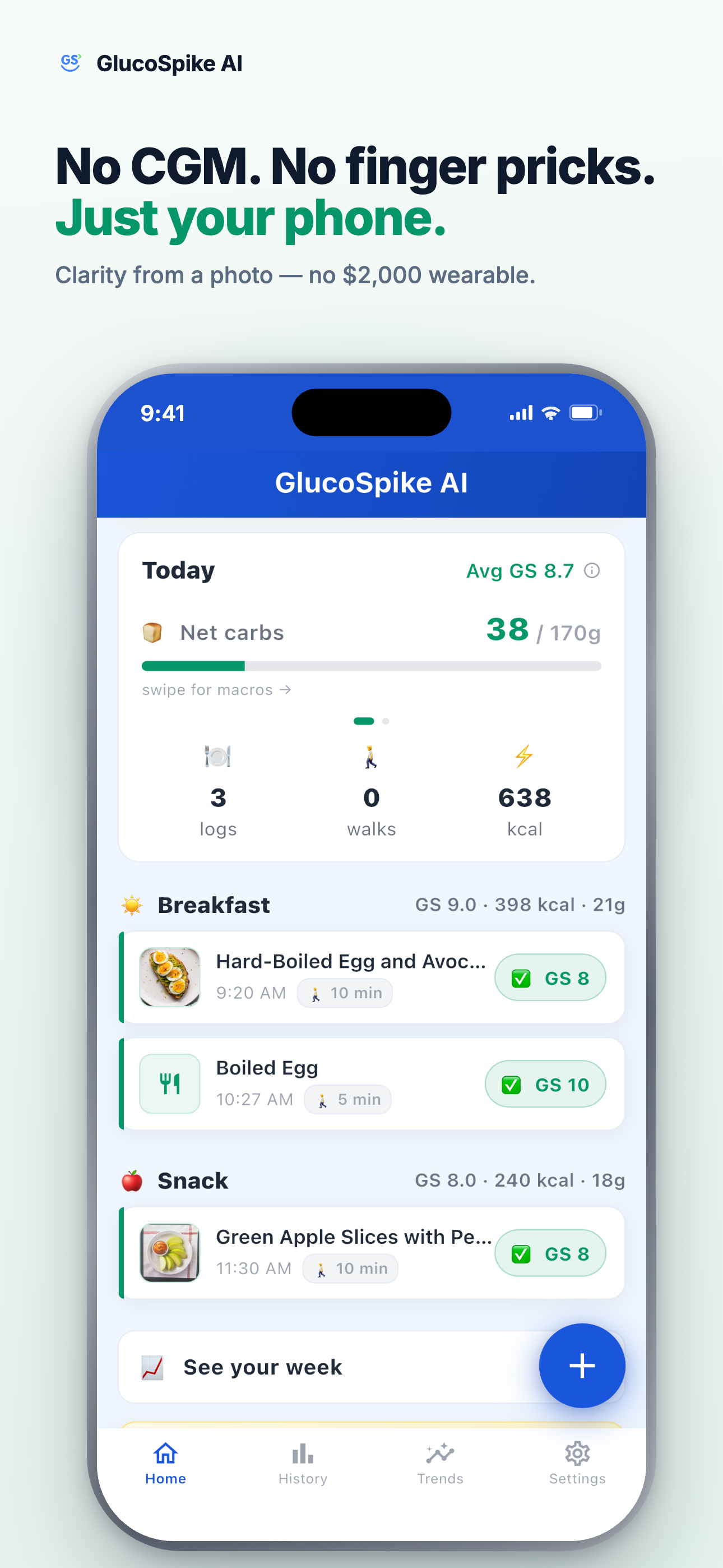
50 g of carbs from lentils and 50 g from white rice hit your blood sugar completely differently. GlucoSpike scores every meal 0–10 — so your range becomes something you can actually track, meal by meal, right from the home screen.
- Snap your meal, get a GlucoScore An instant 0–10 rating of how it will hit your glucose — in about 5 seconds.
- Watch your carbs fill up against your range Net carbs tracked against your daily target, meal by meal — right on the home screen.
- Know if your range is working Weekly trends show whether steady days are becoming your normal — no CGM needed.


Free to try · no CGM or wearable needed
Why Your Ideal Carb Intake Is Personal
There is no universal carb number. A 25-year-old runner and a 55-year-old with prediabetes can eat the same plate of pasta and have completely different glucose responses. Your daily carb needs depend on how many calories you burn (driven by your size, age, sex, and activity), your goals, and how sensitive your body is to insulin.
For generally healthy adults, U.S. Dietary Guidelines put carbohydrates at 45 to 65% of daily calories. For people with prediabetes, insulin resistance, type 2 diabetes, or PCOS, research supports shifting lower: the American Diabetes Association's consensus report found that reducing overall carbohydrate intake has the most evidence for improving blood glucose of any dietary strategy.
Within your range, how you eat carbs matters too. Pairing them with protein, fat, or fiber, eating vegetables before starches, and taking a short walk after meals have all been shown to measurably blunt the glucose rise from the same plate. Timing counts as well — many people tolerate carbs better earlier in the day than late at night.
Frequently Asked Questions
How many grams of carbs should I eat per day? ▾
For most healthy adults, U.S. Dietary Guidelines suggest 45 to 65% of daily calories from carbohydrates, which is roughly 225 to 325 grams on a 2,000-calorie diet. If you have prediabetes, insulin resistance, type 2 diabetes, or PCOS, a moderately lower range is often recommended to reduce post-meal glucose spikes. This calculator estimates your personal range from your age, sex, height, weight, activity level, goal, and blood sugar profile.
How does this carb calculator work? ▾
It first estimates your daily calorie needs using the Mifflin-St Jeor equation, a validated formula that predicts resting energy expenditure from your age, sex, height, and weight, adjusted for your activity level. If your goal is weight loss, it subtracts a moderate 500-calorie deficit. It then applies a carbohydrate percentage range appropriate to your blood sugar profile and converts that to grams (each gram of carbohydrate provides 4 calories).
How many carbs per day for prediabetes or insulin resistance? ▾
There is no single official number, but many clinicians suggest a moderate intake of roughly 35 to 45% of calories from carbs for prediabetes, often around 130 to 180 grams per day depending on your size and activity. Just as important is spreading carbs evenly across meals and choosing lower-glycemic sources — a large carb load in one sitting causes a bigger glucose spike than the same total split across the day.
How many carbs per day for type 2 diabetes? ▾
The American Diabetes Association does not set one ideal carb amount for everyone, but its consensus report notes that reducing overall carbohydrate intake has the most evidence for improving blood glucose. Many people with type 2 diabetes do well between roughly 100 and 150 grams per day, though some go lower under medical supervision. If you take insulin or medications like sulfonylureas, do not cut carbs sharply without talking to your doctor first, because your medication dose may need to change.
How many carbs should I eat to lose weight? ▾
Weight loss ultimately comes from a calorie deficit, not from carbs alone, but a moderately lower carb intake (roughly 30 to 50% of calories depending on your profile) helps many people by steadying glucose, reducing cravings, and making the deficit easier to sustain. This calculator builds in a moderate 500-calorie deficit when you select the weight loss goal, which supports about one pound of loss per week.
Is there a minimum amount of carbs I need? ▾
The Institute of Medicine sets the Recommended Dietary Allowance for carbohydrates at 130 grams per day for adults, based on the glucose the brain typically uses. Many people eat below that safely — the body can produce glucose from other sources — but very-low-carb diets are a significant change that should be discussed with a healthcare provider, especially if you take blood sugar medications.
Do all carbs affect blood sugar the same way? ▾
No, and this is why a gram target is only half the picture. Fifty grams of carbs from steel-cut oats, with their intact fiber, produce a much smaller and slower glucose rise than 50 grams from white bread or fruit juice. Fiber, protein, fat, food order, and even the time of day all change your glucose response. That is exactly what GlucoSpike is built to show you, meal by meal.
This calculator provides a general educational estimate based on population-level formulas and dietary guidelines. It is not medical or nutritional advice, and it cannot account for your medications, lab results, pregnancy, kidney disease, or other individual factors. If you have diabetes, take insulin or glucose-lowering medications, or have any medical condition, consult your doctor or a registered dietitian before changing your carbohydrate intake.