 GlucoSpike AI
 · Chai
Best CGM 2026: Dexcom vs Libre vs Stelo vs Libre Rio — Full Comparison by Accuracy & Cost
Dexcom G7 ranks #1 for accuracy (MARD 8.2–9.1%), FreeStyle Libre 3 Plus for value (~$160/mo), and Dexcom Stelo for OTC access (~$99/mo). Full head-to-head comparison of every major CGM in 2026 — by real accuracy data, monthly cost without insurance, wear time, and who each device is actually built for.
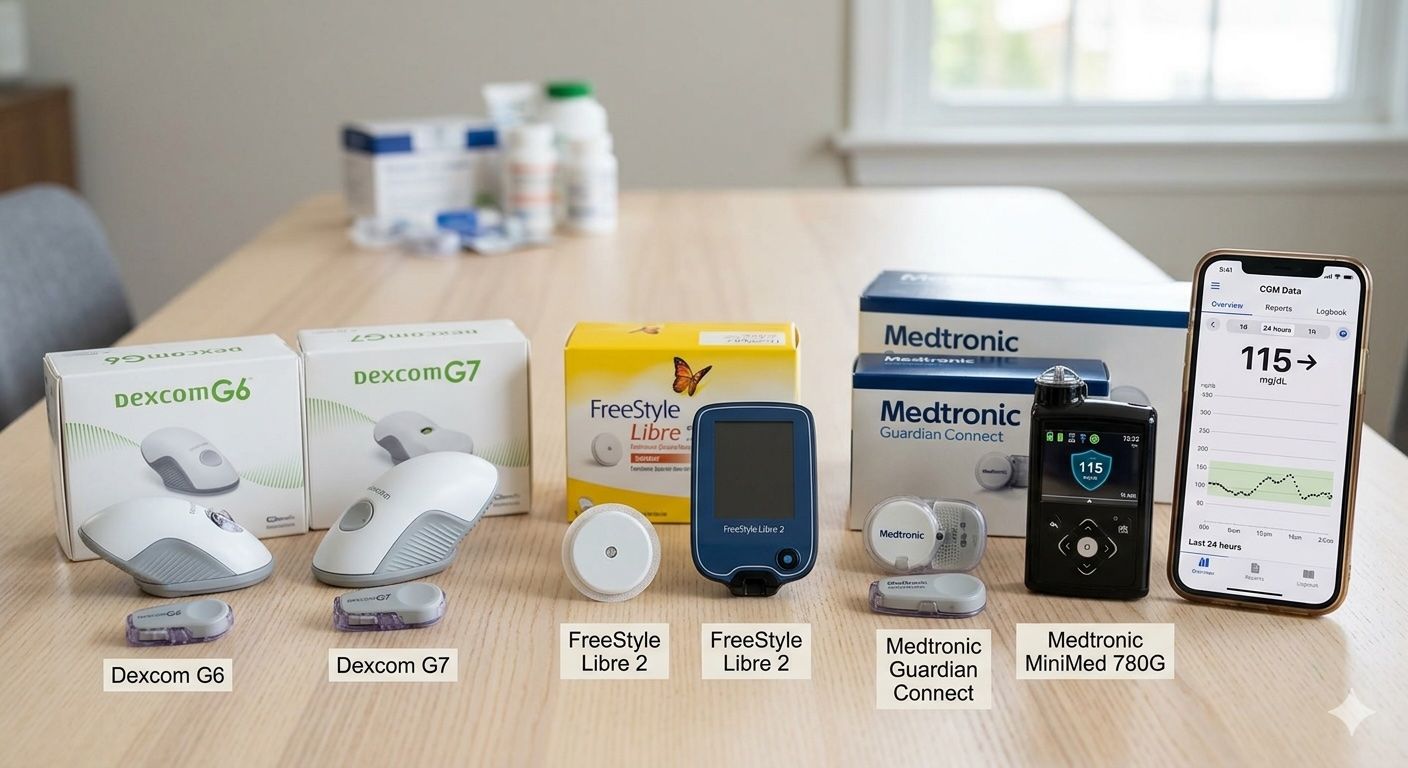
The CGM market has grown fast. There are now more options than ever — prescription devices, over-the-counter sensors, pump-integrated systems, and standalone monitors. Picking the right one depends entirely on what you're trying to manage and how much you're willing to spend.
Here's an honest ranking of the top 5 CGM devices in 2026.
1. Dexcom G7 — Best Overall Accuracy and Alerts
Best for: Type 1 diabetes, insulin-dependent Type 2, anyone who needs real-time alerts
Key specs:
- Sensor wear time: 10 days (G7 15 Day variant: up to 15 days)
- MARD accuracy: ~8.2–9.1% (clinically strong)
- Warm-up time: 30 minutes
- Readings: Every 5 minutes, automatic push to phone
- Insulin pump integration: Yes (Tandem t:slim X2, Omnipod 5)
- Prescription required: Yes
- Approximate cost without insurance: $320–$400/month
Dexcom G7 is the gold standard for real-time CGM. It has the fastest warm-up time of any major CGM (30 minutes), strong predictive low alerts, and integrates with the most insulin pump systems. If you're managing Type 1 diabetes or need automated insulin delivery, this is the device.
Ready to try the G7 for yourself? Check current pricing and availability on Dexcom's site. View Dexcom pricing →
The catch: It's the most expensive option at $3,800–$5,000/year without insurance. And if you don't need insulin pump integration or high-frequency alerts, you're paying for features you won't use.
2. FreeStyle Libre 3 Plus (Abbott) — Best Value and Longest Wear
Best for: Type 2 diabetes, budget-conscious users, people who prefer less intrusive monitoring
Key specs:
- Sensor wear time: 15 days
- MARD accuracy: ~8.9% (excellent)
- Warm-up time: 60 minutes
- Readings: Every minute, automatic
- Insulin pump integration: Yes (multiple brands)
- Prescription required: Yes
- Approximate cost without insurance: ~$160/month (~$1,920/year)
Why it's #2: The Libre 3 Plus gives you class-leading accuracy, the longest sensor wear time of any major CGM, and a significantly lower price point than Dexcom. Abbott claims it's priced about 60% lower than other CGM systems at list price. For most Type 2 users not on intensive insulin therapy, this is the better value.
The catch: Warm-up takes 60 minutes vs. Dexcom's 30. Customer support has received mixed reviews. And if real-time predictive alerts are critical for your care, Dexcom is still the stronger choice.
3. Dexcom Stelo — Best OTC CGM for Prediabetes and Non-Insulin Users
Best for: Prediabetes, Type 2 diabetes not on insulin, metabolic health enthusiasts
Key specs:
- Sensor wear time: 15 days
- MARD accuracy: Comparable to G7 (same underlying platform)
- Warm-up time: 30 minutes
- Readings: Every 5 minutes
- Prescription required: No (FDA-approved OTC)
- Approximate cost: ~$99/month (2 sensors)
Why it's #3: Stelo was the first FDA-approved over-the-counter CGM in the US (approved March 2024). No prescription, no doctor's visit, just order and wear. It's specifically designed for people aged 18+ who have Type 2 diabetes (not on insulin) or prediabetes. It's the lowest-friction entry point to CGM technology.
The catch: It's OTC but still ~$1,200/year. It also doesn't have the same hypoglycemia alert features as the prescription G7, so it's not appropriate for people at risk of dangerous lows.
4. Abbott Libre Rio — Best OTC Budget Option
Best for: Budget-focused prediabetes and Type 2 users who want OTC access
Key specs:
- Sensor wear time: 14 days
- Prescription required: No (FDA-approved OTC)
- Approximate cost: Slightly lower than Stelo at list price
- Readings: Every minute
Why it's #4: Libre Rio is Abbott's answer to Stelo in the OTC space. It brings the Libre platform's strong track record to an over-the-counter format, giving budget-focused users a no-prescription option with 14-day wear. It's particularly strong for users already familiar with the Libre ecosystem.
The catch: As a newer OTC entrant, it has less real-world review data than the prescription Libre 3 Plus. Features may vary compared to prescription counterparts.
5. Medtronic Simplera — Best for Medtronic Pump Users
Best for: People already using a Medtronic insulin pump
Key specs:
- Sensor wear time: 7 days
- MARD accuracy: Less favorable in head-to-head studies vs. Dexcom and Libre
- Insulin pump integration: Yes — exclusive to Medtronic MiniMed 780G
- Prescription required: Yes
- Approximate cost: Higher than Libre, comparable to Dexcom
Why it's #5: The Simplera shines in one specific scenario: you're already on a Medtronic pump and want seamless automated insulin delivery. The integration with the MiniMed 780G is best-in-class for that ecosystem.
The catch: In standalone accuracy comparisons, Simplera has trailed both Dexcom and Libre 3. The shorter 7-day wear time also means more frequent sensor changes. Unless you're in the Medtronic ecosystem, there are better options.
Quick Comparison Table
| Device | Wear Time | MARD | OTC? | Est. Monthly Cost | Best For |
|---|---|---|---|---|---|
| Dexcom G7 | 10–15 days | ~8.2–9.1% | No | ~$350–400 | T1D, insulin users |
| FreeStyle Libre 3 Plus | 15 days | ~8.9% | No | ~$160 | T2D, value seekers |
| Dexcom Stelo | 15 days | ~G7-level | Yes | ~$99 | Prediabetes, OTC |
| Abbott Libre Rio | 14 days | Libre-level | Yes | ~$90–100 | Budget OTC |
| Medtronic Simplera | 7 days | Lower | No | ~$250+ | Medtronic pump users |
Who Doesn't Need Any of These?
Here's something worth saying clearly: most people researching CGMs for the first time don't actually need one yet.
If your goals are:
- Understanding how your meals affect your blood sugar
- Managing prediabetes through diet and lifestyle
- Building better eating habits around glucose
…then you're paying for real-time 24/7 monitoring when what you really need is meal-level glucose awareness.
That's the gap GlucoSpike AI fills. For $39.99/year, GlucoSpike scores every meal you log on a 0–10 scale for glucose impact — no sensor, no hardware, no prescription. It's the right starting point before you decide whether a CGM is worth $1,200–$5,000/year for your situation.
Not ready to spend $100+/month on a CGM? Try GlucoSpike AI free for 7 days and see how your meals score.
CGM Options in 2026: Fast Comparison and Who Each Is For
Below is a concise comparison table of the main CGM options discussed, followed by a short summary of which device fits which situation.
| Device | MARD (Accuracy) | OTC? | Est. Monthly Cost (No Insurance) | Wear Time | Best For |
|---|---|---|---|---|---|
| Dexcom G7 | ~8.2–9.1% | No | $350–400 | 10–15 days | Type 1, insulin-dependent Type 2, closed-loop pump users |
| FreeStyle Libre 3 Plus | ~8.9% | No | ~$160 | 15 days | Type 2 (especially on insulin), value-focused prescription users |
| Dexcom Stelo | G7-level (similar platform) | Yes | ~$99 | 15 days | Type 2 not on insulin, prediabetes, metabolic tracking (OTC) |
| Abbott Libre Rio | Libre-level (similar to Libre 3 Plus) | Yes | ~$89–99 | 14 days | Budget OTC users with Type 2 / prediabetes, Abbott ecosystem fans |
| Medtronic Simplera | Higher MARD (less accurate vs. Dexcom/Libre) | No | $250+ | 7 days | Existing Medtronic MiniMed 780G pump users only |
Quick Device Recommendations by Situation
- Type 1 / intensive insulin therapy: Dexcom G7 (best alerts + pump integration).
- Type 2 on insulin: FreeStyle Libre 3 Plus for value; Dexcom G7 if you need stronger alerts or specific pump integration.
- Type 2 not on insulin: Dexcom Stelo or Abbott Libre Rio (both OTC, no prescription).
- Prediabetes / metabolic health: Stelo or Libre Rio are options but often overkill on cost; a meal-scoring approach like GlucoSpike AI is usually a better first step.
- Medtronic pump users: Medtronic Simplera, but only because of 780G closed-loop integration.
Cost Snapshot (Without Insurance)
- Dexcom G7: $350–400/month ($4,000–5,000/year)
- FreeStyle Libre 3 Plus: ~$160/month (~$1,920/year)
- Dexcom Stelo (OTC): ~$99/month (~$1,188/year)
- Abbott Libre Rio (OTC): ~$89–99/month (~$1,068–1,188/year)
- Medtronic Simplera: $250+/month
If your primary goal is understanding how meals affect your glucose (especially with prediabetes or early metabolic issues), starting with a low-cost meal scoring tool like GlucoSpike AI ($39.99/year) is usually more appropriate than jumping straight into a $1,200–$5,000/year CGM subscription.
Not ready for a CGM subscription? You can try GlucoSpike AI for 7 days at: https://glucospike.ai
- CGM
- continuous glucose monitor
- diabetes technology
- Dexcom
- FreeStyle Libre
- Medtronic
- prediabetes
- Type 1 diabetes
- Type 2 diabetes
- glucose monitoring
"Sugar-free" doesn't mean spike-free. Scan it and know.
The GlucoSpike app includes a free barcode scanner — point your camera at any packaged product and get an instant GS Score showing how it will hit your blood sugar, plus what to grab instead. Product data comes from Open Food Facts, a public nonprofit database: 4M+ products, 150+ countries. Free forever.


Scanner free forever · No credit card · See how it works →