 GlucoSpike AI
Are Blueberries Good for Diabetes?
GI, safe portion & better swaps
Yes, blueberries are good for diabetes. They have a glycemic index of 53 (low) and a glycemic load of 9 per serving. Safe portion: 3/4 to 1 cup fresh or frozen (110–148 g).
Reviewed by GlucoSpike AI · Updated October 15, 2026
GlucoSpike Preview
Blueberries
Typical serving · eaten on its own
7 /10
GlucoScore
Minor Impact
More sugar than other berries, but the fiber keeps a normal handful gentle.
- 3.6 g of fiber
- Small glycemic load
- Slow-release sugar
Nutrition per serving
84
kcal
21.4g
carbs
1.1g
protein
0.5g
fat
3.6g
fiber
Stick to about a cup and have them with plain Greek yogurt. Dried blueberries concentrate the sugar.
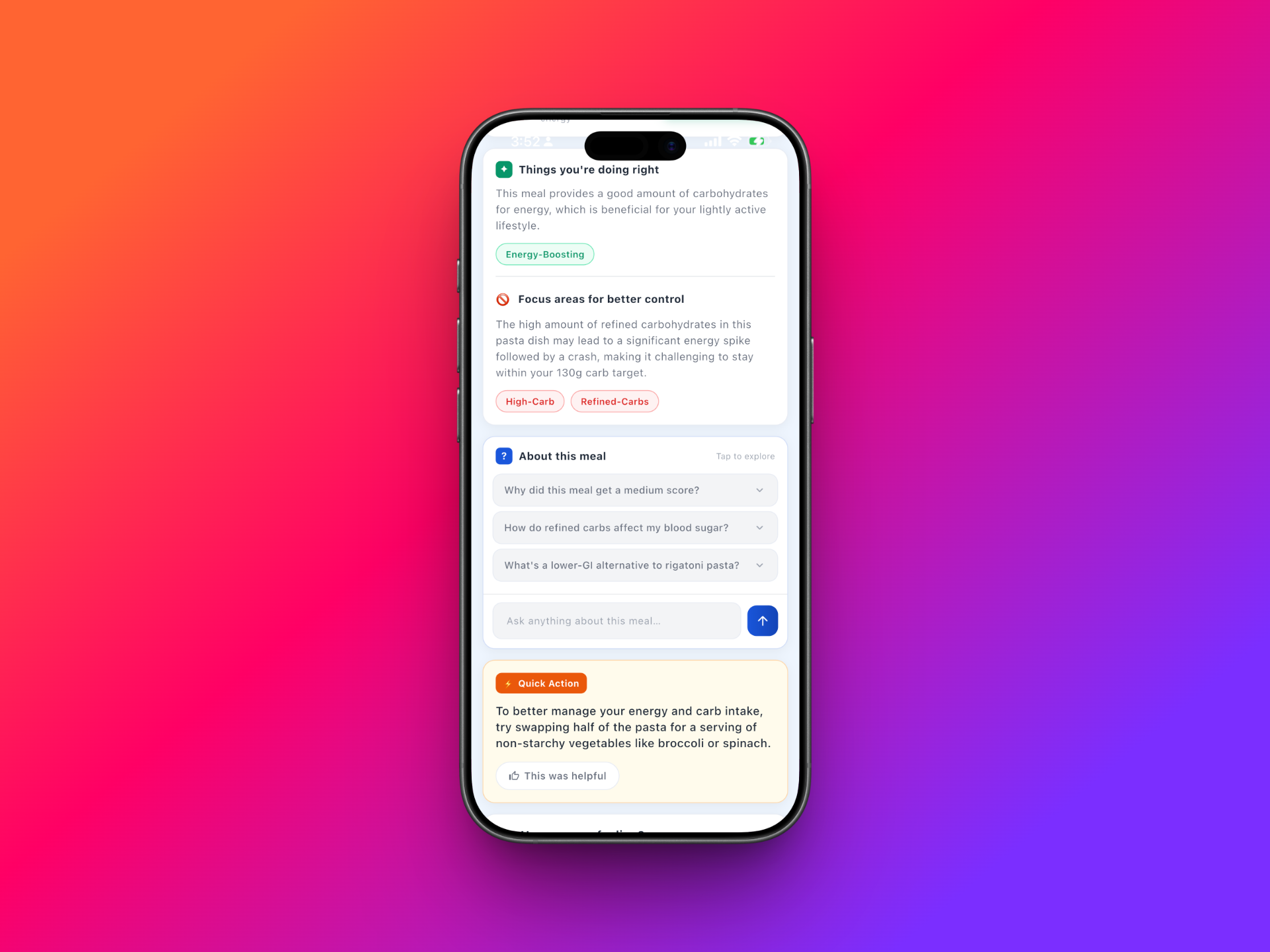
Snap your full plate in the app to see what's driving the score and a swap that fits.
Get the appGlycemic index
53 Low
Glycemic load 9 per serving
Safe portion
3/4 to 1 cup fresh or frozen (110–148 g)
This is for one serving (1 cup fresh (148 g)) on its own. What you eat with it and how much changes the result. Test your own response
The longer answer
Yes, blueberries are a good fruit choice for people managing blood sugar. A cup has about 18 g of net carbs and a GI around 53, which works out to a low glycemic load in a normal serving. They are also one of the richest common sources of anthocyanins, plant compounds studied for their potential role in insulin sensitivity. Keep the portion to about a cup and watch out for blueberry muffins, pancakes, and sweetened yogurts, which are mostly flour and sugar.
Glycemic index & load
Glycemic Index (GI)
53
LowGlycemic Load (GL)
9
LowFiber
3.6
3.6 g per cupFresh blueberries test around 53, at the upper end of the low-GI range. A cup carries about 18 g of net carbs, which gives a low glycemic load of around 9. Dried blueberries are far more concentrated, and "blueberry" muffins, waffles, and bars get most of their glycemic load from flour and added sugar rather than the fruit.
How blueberries affect blood sugar
- → More sugar than other berries: about 15 g of natural sugar per cup is roughly double strawberries.
- → Easy to overeat: small berries are easy to eat by the handful straight from the container.
- → Dried blueberries concentrate sugar: a quarter cup of dried berries can carry as much sugar as two cups of fresh.
- → Baked goods do the damage: blueberry muffins and pancakes are refined flour and sugar with a little fruit.
- → Fiber helps: 3.6 g of fiber per cup slows absorption, keeping the glycemic load low at a normal portion.
Safe portion size for diabetes
✓ Recommended: 3/4 to 1 cup fresh or frozen (110–148 g)
- ✓ Measure a cup into a bowl rather than eating from the container.
- ✓ Frozen wild blueberries are a budget-friendly year-round option with no added sugar.
- ✓ Add blueberries to protein-rich foods instead of eating them alone.
- ✓ Choose fresh or frozen over dried, and check dried-fruit labels for added sugar.
Test your own response to blueberries
The GlucoScore of 7/10 (minor impact) is for a typical person eating one serving on its own. Higher is better. Your meal is different: what you pair it with, the portion, and how it's cooked all change the result.
No meter? Score it before you eat
Take a photo of your plate in GlucoSpike. You get a 1–10 GlucoScore for the whole meal in about 5 seconds, plus what's driving it and a swap if it's high. No CGM, meter or finger prick.
Have a glucose meter or CGM? Check it after, too
- 1. Check before you eat. Take a reading right before the meal — this is your baseline.
- 2. Eat a measured portion. 3/4 to 1 cup fresh or frozen (110–148 g) — the same way you normally would.
- 3. Check at 1 hour and 2 hours. Note the highest reading and how far it rose above your baseline.
- 4. Read the result. A rise under 30 mg/dL (1.7 mmol/L) is gentle; 30–50 mg/dL is moderate; over 50 mg/dL, or any reading above 180 mg/dL (10.0 mmol/L), means a smaller portion, a better pairing, or a swap from the list below.
Log the reading next to the meal in GlucoSpike and you'll see over a week which foods your body handles well.
Foods to avoid pairing with blueberries
✗ Blueberry muffins or pancakes
These are mostly refined flour and sugar, carrying several times the carbs of the fruit alone.
✗ Maple or pancake syrup
Pouring syrup over blueberries adds fast sugar to an already sweet fruit.
✗ Sweetened fruit-on-the-bottom yogurt
Fruit-flavored yogurts often add 10–20 g of sugar per cup.
✗ Juice-based smoothies
Juice adds liquid sugar and blending speeds absorption.
Better swaps for blueberries
Raspberries
About half the net carbs per cup, with more than twice the fiber.
Strawberries
Lower GI (around 40) and about half the sugar per cup.
Blackberries
High in fiber and lower in net carbs than blueberries.
Cherries (fresh)
A low-GI fruit (around 22) when eaten fresh, though portion still matters.
GlucoSpike AI verdict
🟢 Good
Blueberries earn a Good rating from GlucoSpike AI. Their low GI, low glycemic load at a one-cup serving, fiber, and antioxidant content make them a smart fruit choice. They carry more sugar than strawberries or raspberries, so portion awareness matters more, and the blueberry in a muffin or pancake does not make it a healthy choice. Scan your yogurt or cereal in the GlucoSpike app to check the added sugar.
The next step
Blueberries is one food. Your plate is the whole story.
A guide like this tells you what's typical. GlucoSpike tells you about the meal in front of you, before you eat it.
- Snap your meal, get a GlucoScore A 1–10 rating of how it's likely to hit your blood sugar, in about 5 seconds.
- See what's behind the spike, and a swap that fits Which part of the plate is doing it, and a smaller change than giving it up.
- Spot your patterns over a week No CGM or wearable needed. Score three meals and you'll start seeing it.


Free to try · no CGM or wearable needed
Frequently asked questions
Are Blueberries Good for Diabetes?
Yes, blueberries are good for diabetes. They have a glycemic index of 53 (low) and a glycemic load of 9 per serving. Safe portion: 3/4 to 1 cup fresh or frozen (110–148 g). Yes, blueberries are a good fruit choice for people managing blood sugar. A cup has about 18 g of net carbs and a GI around 53, which works out to a low glycemic load in a normal serving. They are also one of the richest common sources of anthocyanins, plant compounds studied for their potential role in insulin sensitivity. Keep the portion to about a cup and watch out for blueberry muffins, pancakes, and sweetened yogurts, which are mostly flour and sugar.
What is the glycemic index of blueberries?
Fresh blueberries test around 53, at the upper end of the low-GI range. A cup carries about 18 g of net carbs, which gives a low glycemic load of around 9. Dried blueberries are far more concentrated, and "blueberry" muffins, waffles, and bars get most of their glycemic load from flour and added sugar rather than the fruit. Glycemic load: 9 per serving (1 cup fresh (148 g)).
Do blueberries raise blood sugar?
Somewhat, but modestly. Blueberries contain natural sugar, so they do raise blood sugar, but their fiber and low GI mean a one-cup serving produces a relatively gentle rise for most people.
How many blueberries can a diabetic eat?
Three-quarters to one cup of fresh or frozen blueberries is a common serving, carrying roughly 14–18 g of net carbs. Pairing them with protein makes the snack more balanced.
Are blueberries good for insulin resistance?
Some studies have linked blueberries and their anthocyanins to modest improvements in insulin sensitivity, though results vary and the research is ongoing. They are best seen as a healthy fruit choice, not a treatment.
Are frozen blueberries as good as fresh for diabetics?
Yes. Frozen unsweetened blueberries have similar nutrition to fresh, and wild frozen blueberries are often higher in anthocyanins. Just avoid frozen berries packed with sugar.
Are dried blueberries okay for diabetics?
In small amounts. Drying removes water and concentrates the sugar, and many brands add more. A tablespoon or two on yogurt is very different from a handful.
Are blueberries better than strawberries for diabetics?
Both are good choices. Strawberries have less sugar and a lower GI per cup, while blueberries are higher in anthocyanins. Alternating between them is a reasonable approach.
This guide is for general education and is not medical advice. Glucose responses vary by person — confirm changes with your doctor and, ideally, your own readings.