 GlucoSpike AI
Is Pineapple Good for Diabetes?
GI, safe portion & better swaps
In moderation, yes: pineapple can fit a diabetes diet. It has a glycemic index of 59 (medium) and a glycemic load of 11 per serving. Safe portion: 1/2 cup fresh chunks (about 80 g), eaten with protein.
Reviewed by GlucoSpike AI · Updated October 15, 2026
GlucoSpike Preview
Pineapple
Typical serving · eaten on its own
6 /10
GlucoScore
Moderate Impact
Sweeter than most fruits with less fiber, and the riper it gets, the more sugar it has.
- Higher sugar fruit
- Relatively low fiber
- Ripeness adds sugar
Nutrition per serving
82
kcal
21.6g
carbs
0.9g
protein
0.2g
fat
2.3g
fiber
Keep it to half a cup of fresh chunks with cottage cheese. Skip the canned kind in syrup.
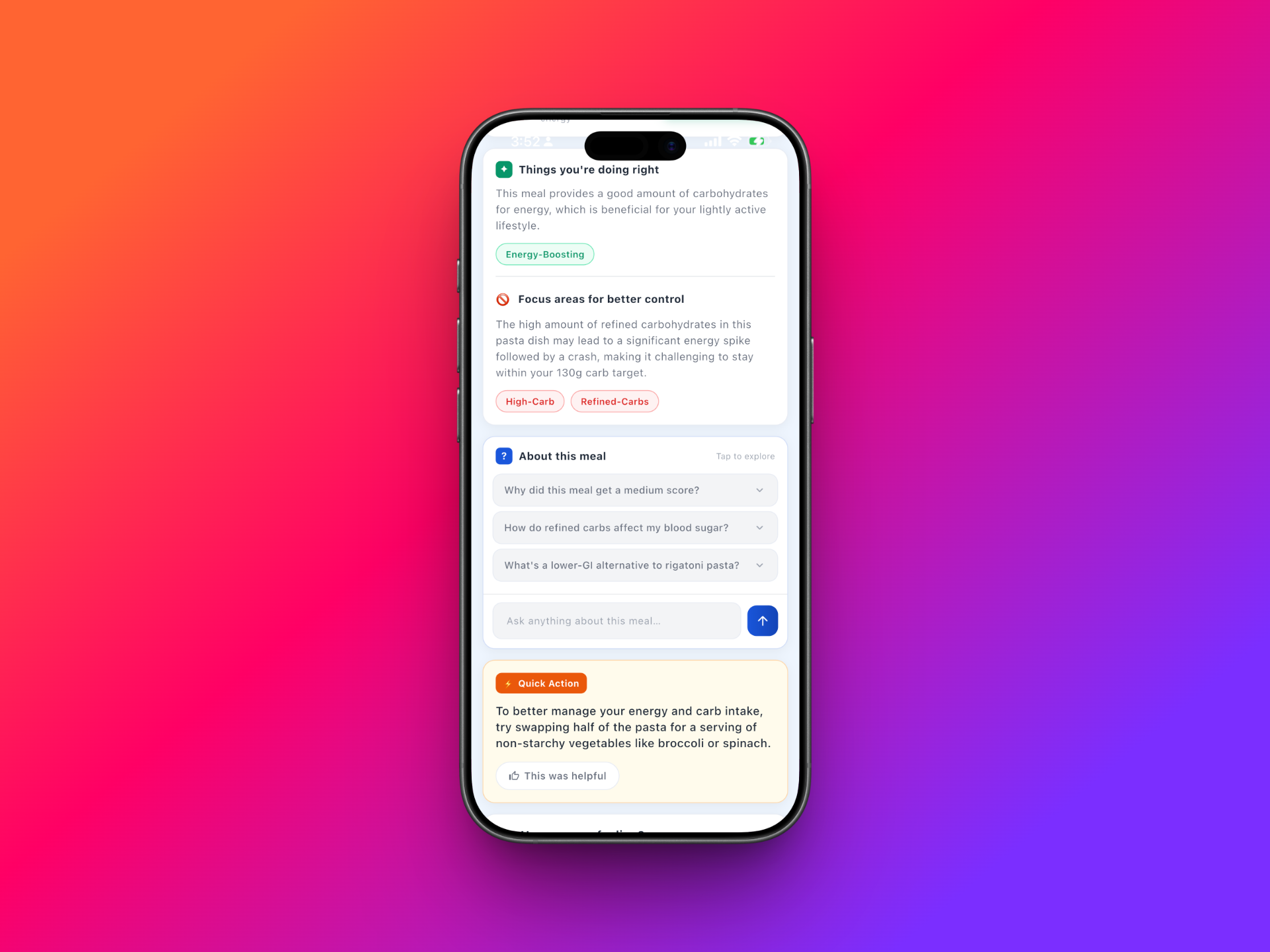
Snap your full plate in the app to see what's driving the score and a swap that fits.
Get the appGlycemic index
59 Medium
Glycemic load 11 per serving
Safe portion
1/2 cup fresh chunks (about 80 g), eaten with protein
This is for one serving (1 cup fresh chunks (165 g)) on its own. What you eat with it and how much changes the result. Test your own response
The longer answer
Pineapple can fit into a diabetes-friendly diet in a smaller portion, but it is one of the sweeter fruits to be careful with. A cup of fresh chunks carries about 19 g of net carbs and 16 g of sugar, with a medium GI around 59. Half a cup eaten with protein is a more comfortable serving. Canned pineapple in syrup, pineapple juice, and dried pineapple are much higher in sugar and are better limited.
Glycemic index & load
Glycemic Index (GI)
59
MediumGlycemic Load (GL)
11
MediumFiber
2.3
2.3 g per cupFresh pineapple tests around 59 on the glycemic index, with reported values from about 51 to 66 depending on ripeness. A cup carries a medium glycemic load of about 11; half a cup drops it into the low range. Canned pineapple in heavy syrup and pineapple juice both carry substantially more sugar per serving.
Why pineapple spikes blood sugar
- → Higher sugar than most fruits: about 16 g of sugar per cup, roughly double strawberries.
- → Relatively low fiber: 2.3 g of fiber per cup is not much to slow down that sugar.
- → Ripeness raises sugar: very ripe, soft pineapple is sweeter and digests faster.
- → Syrup and juice: canned pineapple in heavy syrup adds sugar, and juice removes the fiber entirely.
- → Common pairings are sweet: pineapple often shows up on pizza, in sweet-and-sour dishes, and in piña coladas.
Safe portion size for diabetes
✓ Recommended: 1/2 cup fresh chunks (about 80 g), eaten with protein
- ✓ Treat pineapple as a garnish or side rather than a big bowl of fruit.
- ✓ Buy fresh or canned in its own juice (not syrup), and drain the liquid.
- ✓ Pair it with cottage cheese, Greek yogurt, or nuts rather than eating it alone.
- ✓ Grill a few slices to serve alongside chicken or pork; the protein slows the sugar.
Test your own response to pineapple
The GlucoScore of 6/10 (moderate impact) is for a typical person eating one serving on its own. Higher is better. Your meal is different: what you pair it with, the portion, and how it's cooked all change the result.
No meter? Score it before you eat
Take a photo of your plate in GlucoSpike. You get a 1–10 GlucoScore for the whole meal in about 5 seconds, plus what's driving it and a swap if it's high. No CGM, meter or finger prick.
Have a glucose meter or CGM? Check it after, too
- 1. Check before you eat. Take a reading right before the meal — this is your baseline.
- 2. Eat a measured portion. 1/2 cup fresh chunks (about 80 g), eaten with protein — the same way you normally would.
- 3. Check at 1 hour and 2 hours. Note the highest reading and how far it rose above your baseline.
- 4. Read the result. A rise under 30 mg/dL (1.7 mmol/L) is gentle; 30–50 mg/dL is moderate; over 50 mg/dL, or any reading above 180 mg/dL (10.0 mmol/L), means a smaller portion, a better pairing, or a swap from the list below.
Log the reading next to the meal in GlucoSpike and you'll see over a week which foods your body handles well.
Foods to avoid pairing with pineapple
✗ Pineapple juice
Juice concentrates the sugar and removes the fiber, raising blood sugar quickly.
✗ Sweet-and-sour sauce
These sauces are often high in sugar, stacking more on top of the fruit.
✗ Piña coladas or tropical cocktails
Combines juice, cream of coconut (sugar), and alcohol.
✗ Pineapple upside-down cake
Caramelized sugar and cake turn the fruit into a high-glycemic dessert.
Better swaps for pineapple
Strawberries
Lower GI (around 40) and less than half the sugar per cup.
Raspberries
Very high fiber and low net carbs per cup.
Cantaloupe
Fewer carbs per cup than pineapple, though GI is in a similar range.
Kiwi
A tart, tropical-tasting fruit with a lower GI (around 50) and good fiber.
GlucoSpike AI verdict
🟡 Moderate
Pineapple gets a Moderate rating from GlucoSpike AI. It has more sugar and less fiber than berries or apples, giving it a medium GI and a medium glycemic load per cup, but a half-cup portion of fresh pineapple with protein is easy to fit in. Juice, syrup-packed cans, and pineapple desserts are the versions to limit. Scan canned fruit in the GlucoSpike app to see how much added sugar it carries.
The next step
Pineapple is one food. Your plate is the whole story.
A guide like this tells you what's typical. GlucoSpike tells you about the meal in front of you, before you eat it.
- Snap your meal, get a GlucoScore A 1–10 rating of how it's likely to hit your blood sugar, in about 5 seconds.
- See what's behind the spike, and a swap that fits Which part of the plate is doing it, and a smaller change than giving it up.
- Spot your patterns over a week No CGM or wearable needed. Score three meals and you'll start seeing it.


Free to try · no CGM or wearable needed
Frequently asked questions
Is Pineapple Good for Diabetes?
In moderation, yes: pineapple can fit a diabetes diet. It has a glycemic index of 59 (medium) and a glycemic load of 11 per serving. Safe portion: 1/2 cup fresh chunks (about 80 g), eaten with protein. Pineapple can fit into a diabetes-friendly diet in a smaller portion, but it is one of the sweeter fruits to be careful with. A cup of fresh chunks carries about 19 g of net carbs and 16 g of sugar, with a medium GI around 59. Half a cup eaten with protein is a more comfortable serving. Canned pineapple in syrup, pineapple juice, and dried pineapple are much higher in sugar and are better limited.
What is the glycemic index of pineapple?
Fresh pineapple tests around 59 on the glycemic index, with reported values from about 51 to 66 depending on ripeness. A cup carries a medium glycemic load of about 11; half a cup drops it into the low range. Canned pineapple in heavy syrup and pineapple juice both carry substantially more sugar per serving. Glycemic load: 11 per serving (1 cup fresh chunks (165 g)).
Does pineapple raise blood sugar?
Yes, moderately. Pineapple has a medium GI and about 16 g of sugar per cup, so it raises blood sugar more than berries. A smaller portion eaten with protein softens the rise.
How much pineapple can a diabetic eat?
About half a cup of fresh pineapple is a common serving that keeps the glycemic load low. A full cup is possible for some people, especially when it is part of a meal with protein.
Is canned pineapple okay for diabetics?
Pineapple canned in its own juice and drained is reasonable in small portions. Pineapple canned in light or heavy syrup carries a lot of added sugar and is best avoided.
Is pineapple juice bad for diabetics?
It is one of the less blood-sugar-friendly ways to have pineapple. Juice removes the fiber and a cup can carry more than 25 g of sugar, which tends to be absorbed quickly.
Is dried pineapple okay for diabetics?
It is best limited. Drying concentrates the sugar and many dried pineapple products are coated in more sugar, making a small handful very high in carbs.
Is pineapple on pizza okay for diabetics?
The pineapple is a small part of the problem; the crust is the main source of carbs. A slice of thin-crust Hawaiian pizza with a salad is more manageable than several slices of thick crust.
This guide is for general education and is not medical advice. Glucose responses vary by person — confirm changes with your doctor and, ideally, your own readings.